China today is one of the very few places on earth where modernity and high-tech cultures can still exist hand-in-hand with tradition.
In big cities like Shanghai or Beijing, it’s very common to see kids with the latest, most advanced smartphones and tablets, but at the same time, their traditional, outdoor activities are still alive and kicking.
Another unique thing is that in China, outdoor traditional games are not only popular with children, but also with the young adults and the elderly. It’s common to find Chinese parks full of young and old people engaging in various traditional sports and games.
Below, we will discuss some of the most popular traditional games and outdoor activities in China.
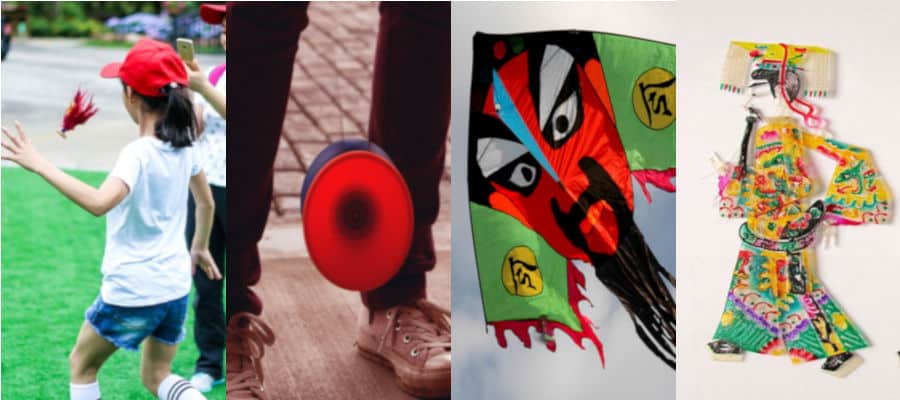
Chinese shadow puppetry (皮戏, píyĭngxì)
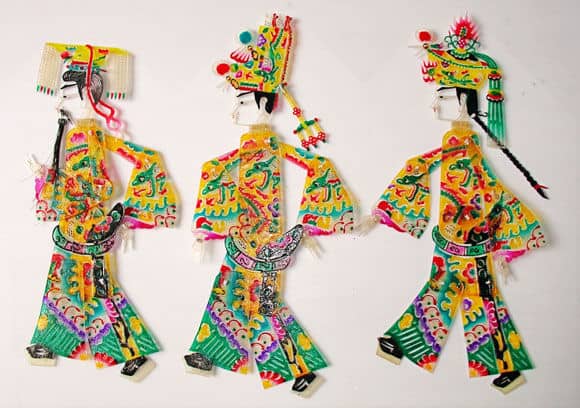
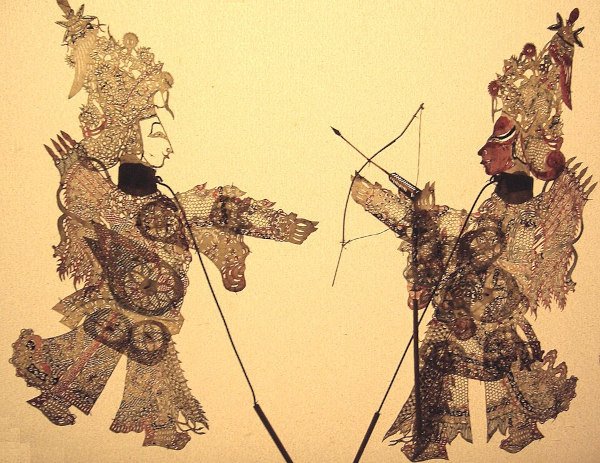
Chinese shadow puppetry—or shadow play—, was originated in the Han dynasty, around (221 BCE to 206 CE221), but peaked in popularity during the Tang (618-907) and Song (960-1279) dynasties.
In a nutshell, shadow puppetry is two-dimensional figures (made of paper, cotton, leather, and other materials) that are placed behind a screen—back then, a thin white cloth—. A light source casts shadows on this screen, and the puppeteers will then manipulate the figures to tell a story with movements, often accompanied by sung narrations.
Legend said a minister of the Han Dynasty happened to see children playing with dolls, and noticed the shadow movements on the floor. He hit upon an idea, and then made a cotton puppet of the emperor’s favorite concubine.
The minister showed the very first shadow play to the emperor, and the tradition stands until today. This story is recorded in the historical Book of Han (Encyclopedia Britannica) and is believed to be the origin of Chinese shadow puppetry.
As mentioned, Shadow puppetry became quite popular during the Song dynasty, with holidays are often accompanied with many shadow puppetry shows.
During the time of the Ming dynasty (1,368 CE-1,662 CE), history recorded that there were 50 shadow puppet troupes in Beijing alone. Back then, the storytellers typically used shadowplay to tell stories surrounding historical events (famous wars, etc.) or Buddhist religious stories.
Chinese shadow puppets are initially made of paper sculpture but are then replaced with donkeys or oxen leather.
This is where the name píyĭngxì came from, pi ying literally meant shadows from leather puppets. Chinese shadow play is not entirely a show of shadow, but more of a silhouette where the figures still retain some color on the screen.
While shadow puppetry was popular entertainment, it also served as a means of education. Many rural communities used these plays to pass down moral lessons, Confucian values, and folklore to younger generations who might not have access to formal schooling. The combination of music, narration, and moving silhouettes created a powerful way to transmit culture orally and visually.
Today, shadow puppetry has been recognized by UNESCO as an Intangible Cultural Heritage of Humanity (2011). Some troupes in provinces like Shaanxi, Hebei, and Gansu still keep the art alive, often blending modern themes with traditional stories.
More information about Shadow Puppetry in our article “Chinese Shadow Puppetry Facts and Stories” -Opens in a new tab.
Take a look at these awesome Shadow Puppets.– Aff.link
Chinese Rattle drum, Tao (鼗) or taogu (鼗鼓) or bolanggu (拨鼓)
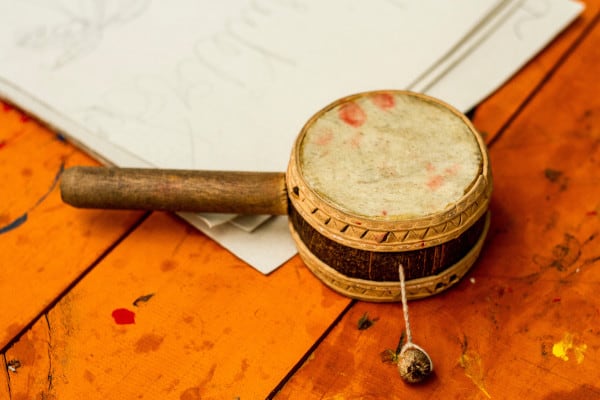
The rattle-drum is one of the oldest toys in China, with the earliest form believed to have appeared as early as the Warring States Period (as early as 403 BCE). Back then, it was strictly a percussion instrument and only in the time of Song dynasty (around 1,000 CE) that the rattle-drum enjoyed huge popularity as a toy for children.
The rattle drum is a small, double-sided membranophone with a handle. A wooden ball (or pellet, hence it’s also often called “pellet drum”) is hung from a string, attached to each end to beat the drum. It is mainly played by swaying the handle, so the balls—or pellets— will beat the drum from both sides, producing a rattling sound.
The rattle drum is also a popular instrument used as noisemakers by street vendors, not only in China but also in Korea, Tibet, Taiwan, Mongolia, India, and throughout East Asia.
This is mainly due to the rhythmic, rattling sounds of the instrument, which are easy to draw attention with. Street peddlers often shouted in cadenced, happy voice together with the rhythmic sounds, literally “drumming-up” business.
Besides being a toy and vendor’s tool, the rattle drum also held symbolic meaning. In ancient times, it was used during religious ceremonies to ward off evil spirits and summon blessings. The rhythmic beat was thought to drive away negative energy.
Interestingly, miniature versions are still popular during Chinese New Year celebrations, as parents buy them for children as a symbol of joy, vitality, and good fortune.
Take a look at these awesome Chinese Rattle drum designs .– Aff.link
Chinese shuttlecock (Jiàn Zi, (子), tī jianzi (踢子), tī jian (踢) or jianqiú.
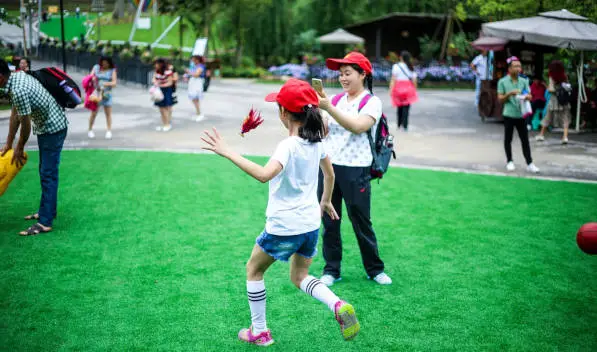
The jianzi—”Shuttlecock”, is still a favorite traditional game in China, which has been around for centuries and enjoyed by both adults and children of any social backgrounds.
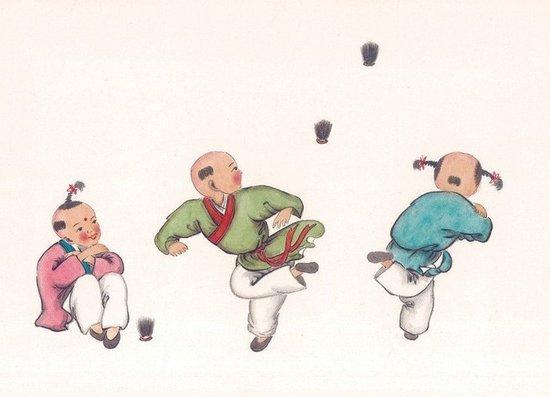
The game itself is pretty simple—not saying it’s easy—, with just one rule: keep the shuttlecock in the air without using the hands. Mainly, we try to get as many kicks as possible without dropping the jianzi. There are various techniques that have been developed over the years from simple kicking to acrobatic heading to powerful overhead kicks.
In China, the sport usually has two main forms: 5 to 10 people circling and kicking the shuttlecock, and “duel Jianzi”, with two kickers or two teams playing against each other, much like soccer. A competitive, government-run game called jianqiu is played on a rectangular court divided by a net — like badminton with kicks instead of rackets—.
According to Chinese legends, Jianzi originated from an ancient game from the Han dynasty called cuju, so it has been around for more than 2,000 years.
In addition to its recreational role, jianzi has been a serious competitive sport since the 20th century. In 1999, the International Shuttlecock Federation (ISF) was established in Berlin, and China has since hosted world championships.
Different regions in China developed their own styles: in Beijing, players emphasize acrobatic kicks and spins, while in southern provinces like Guangdong, fast-paced rallies resembling badminton are more common.
Beyond fitness, the game has social importance: playing jianzi in parks often becomes a way for strangers to bond quickly, reflecting the communal aspect of Chinese public life.
Take a look at these awesome Chinese Shuttlecock designs .– Aff.link
Chinese Yoyo (Dǒu Kōng Zhú,空竹)
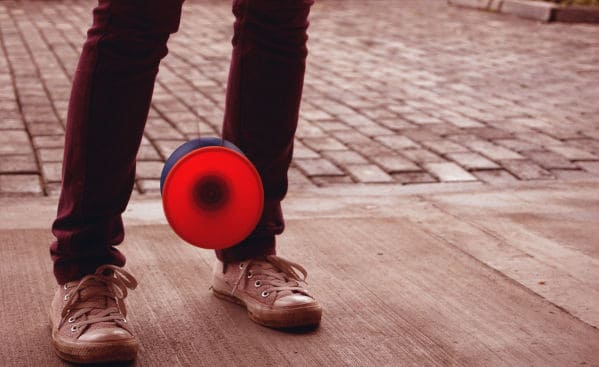
The Dǒu Kōng Zhú—known in the west as diabolo or diablo—is a traditional Chinese toy characterized by two equally-sized “bells” or “discs” that are connected in the middle by a horizontal piece of wood (today, replaced with plastic). The toy will spin on a string, attached to two wooden sticks held in both hands.
The original, Chinese version of the Dǒu Kōng Zhú produces a whistling or humming sound as air passes through the sides when it is spun, giving the nickname “wind bell”, or “empty bell”.
As the player grows in skills, the Chinese yo-yo can be played with a wide variety of tricks and techniques, similar to western yo-yo. However, since the Dǒu Kōng Zhú is not attached to the string, it can be tossed around for more variety in tricks, and can even be passed between people.
Historically, the oldest reference to the Tzuh-ling, “empty bell”, was found in the annals of the Ming Dynasty from around 1,386 CE to 1,644 CE. Back then, the yo-yos were made from bamboo or wood—both materials are still popular today in China.
The whistling sound of the traditional bamboo yo-yo was not just for fun. It was believed to chase away evil spirits in winter, as the humming noise echoed through the cold, quiet air. This is why many Chinese festivals in northern China featured yo-yo performers at the start of spring — to “wake up” the season and invite good luck.
Today, modern yo-yos made from plastic are lighter and easier to use, which has led to large-scale yo-yo competitions in cities like Beijing and Tianjin. It’s even taught in schools as a way to train children’s hand-eye coordination and patience.
Click here to see some Chinese Yoyo designs.– Opens in new tab.
Chinese jump rope (Tiào Pí Jīn, 跳皮筋)
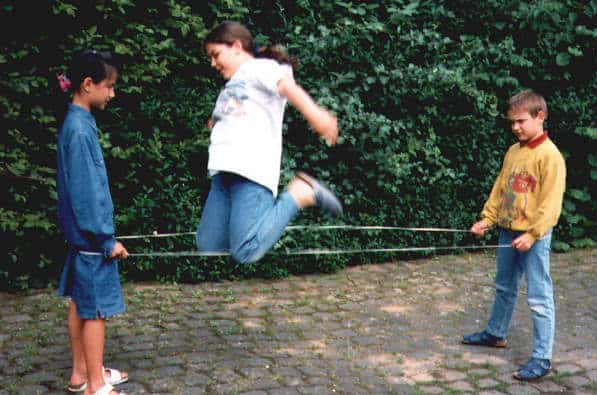
The Tiào Pí Jīn, literally meant “rubber band jump rope”, and also often called iào xiàng pí shéng or “jump the rubber rope”, is a traditional Chinese game played by at least three players: two players held the long rubber band with their legs, typically around 16 feet in length tied to a circle.
These two players typically stand around 9 feet apart from each other, and the third player jump “inside” the rope and tries to perform a series of moves without passing or making an error—often accompanied by singing—. There are many jump patterns to follow, and most of them have their own songs.
As the jumper moves through the levels, the position of the string is raised from ankle to waist and finally to the chest, so the jumping will be more rigorous and difficult. As the rope gets too high to jump over, the player can either kneel and use their hands to finish the pattern, or simply stop the game at this point.
The songs sung during this game often carry cultural and local flavor. For example, in northern China, children sing rhymes referencing seasonal foods, zodiac animals, or famous places. These rhymes help preserve local dialects and traditions, making the game both playful and educational.
The flexibility of the rules — allowing hand use or kneeling once the rope rises — reflects the Chinese philosophy of adaptation and resilience in play. Even losing is often taken lightheartedly, emphasizing cooperation and fun rather than competition.
The Tiào Pí Jīn is believed to be originated from the time of the Tang dynasty, around the 7th century CE. It gained popularity in the west around the 1960s, with adapted names like gummitwist in German or elastics in England.
Check out our “Free Culture Library“. We have compiled some great free resources, about Chinese culture, for your research.
Chinese kites (Zhiyuan)
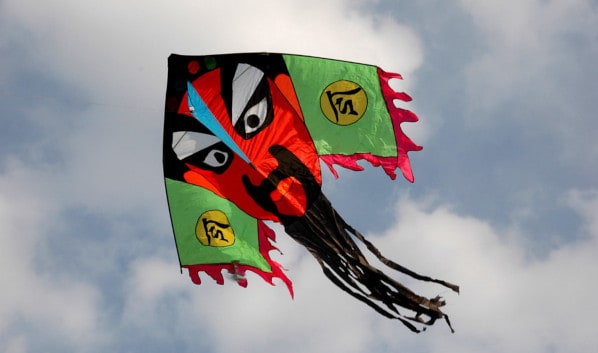
The Chinese kite called Zhiyuan in northern China and Yao-zi in southern China is both a traditional folk handicraft and traditional toy for Children. The most popular kites in China today originated mainly from Beijing, Weifang, and Tianjin.
According to Chinese history, Chinese kites first appeared during the Spring and Autumn Period, around 700-476 BCE, the philosopher Mo Zi, or Mo Tse, originally designed the kite as a military technology to spy on the situation of the enemy from the air.
However, the technology was only realized far later in 200 BCE, during the Chu-Han War, when general Zhang Liang ordered his troops to fly kites in the heavy fog. Children sat on these large kites and played songs on flutes.
The Chu warriors, according to legend, missed their homes hearing the melodies and scattered without fighting.
During the Tang dynasty (618-900 CE), kites have transformed to be traditional art. Making and flying kites were then associated with the pleasing season of spring, and until today is still believed to be a symbol of health and prosperity. (Further reading: “Chinese Kites History and Origin” and “Historical and Modern Facts about Chinese Kites“)
In addition to their artistic role, kites carry strong symbolic meaning in Chinese culture. It is believed that flying a kite and then cutting the string lets misfortune and illness “fly away,” leaving health and good luck behind. This ritual is still practiced during spring kite festivals, especially in Weifang, Shandong Province, often called the “Kite Capital of the World.”
Kites are also linked to literature: Tang dynasty poets like Li Bai and Du Fu often referenced kite flying as a metaphor for freedom, longing, and the human spirit.
Take a look at these awesome Chinese Kites designs – Aff.link
The Social Role of Traditional Games
One of the most remarkable aspects of traditional Chinese games is their intergenerational character. Unlike many modern pastimes that are age-specific, these activities often bring together children, parents, and grandparents in the same space.
In city parks and rural village squares, it is common to see elderly men playing jianzi with teenagers, or grandparents patiently teaching children the art of kite flying. These moments are more than just leisure; they represent the transmission of cultural memory from one generation to the next.
Traditional games also function as a form of social glue in Chinese communities. In a society that historically valued collective life — from courtyard housing in northern cities to the tightly knit villages of the south — play has always been a communal event.
Activities like shadow puppetry or rattle-drum performances were often staged during festivals, temple fairs, or market days, when the entire community could gather. Even today, games such as tiào pí jīn (jump rope) or group jianzi are often played in circles, emphasizing cooperation, rhythm, and harmony rather than pure competition.
These games also reflect deeper Chinese cultural values:
- Harmony and balance — Many activities, like shuttlecock kicking or the Chinese yo-yo, emphasize controlled movement, rhythm, and flow, echoing Daoist ideas of balance and natural movement.
- Perseverance and skill-building — The gradual mastery of tricks in kongzhu (Chinese yo-yo) or the increasingly difficult levels of jump rope mirror the Confucian ethic of self-improvement through practice.
- Community over individualism — Unlike competitive sports that create clear winners and losers, traditional games often prioritize group enjoyment, storytelling, or shared ritual.
Moreover, these outdoor activities play a crucial role in public health and social wellbeing. For many elderly Chinese, especially in urban areas, participating in kite flying, jianzi, or square dancing provides not only physical exercise but also companionship. Parks become lively hubs of interaction, where strangers can join in a circle game or strike up conversations, reducing social isolation.
In this sense, traditional games are not just playful diversions. They are living embodiments of cultural continuity, reinforcing bonds within families, strengthening community ties, and providing a shared language of joy that transcends age, class, and time.
Cross-Cultural Parallels: Chinese Games and Their Western Counterparts
Many of China’s traditional outdoor games have close relatives in other cultures, showing how play is a universal human experience even if the cultural expression is different.
- Shadow Puppetry vs. European Marionettes
While China developed shadow puppetry, Europe developed marionettes and hand puppets. Both were used not only for entertainment but also to teach moral lessons, though Chinese shadow play relied on silhouettes and light while Western marionettes emphasized lifelike three-dimensional movement. - Rattle Drum vs. Tambourine/Hand Drums
The Chinese bōlànggǔ is a unique combination of toy and instrument. In Europe, small percussion instruments like the tambourine had a similar role in festivals and folk dances, though they never evolved into toys for children the way the rattle drum did in China. - Jianzi vs. Hacky Sack
Jianzi is strikingly similar to the Western “Hacky Sack,” which became popular in the U.S. in the 1970s. Both games involve keeping an object aloft with the feet, fostering agility, rhythm, and teamwork. The main difference lies in the object used — a weighted shuttlecock in China versus a small beanbag in the West. - Chinese Yo-Yo vs. Diabolo in Europe
Interestingly, the diabolo was introduced to Europe from China through trade during the 18th and 19th centuries. In France, it became a fashionable pastime among the elite, while in China it remained strongly tied to folk festivals and traditional symbolism. - Jump Rope (Tiào Pí Jīn) vs. Western Jump Rope Games
Jump rope is also widely played in Western countries, often accompanied by rhymes or chants. The Chinese version, however, uses a loop of elastic rather than a rope, which changes the movement style and difficulty. Both cultures integrate singing into the game, showing how rhythm and rhyme naturally enhance play. - Chinese Kites vs. European Kite Flying
Although kites originated in China, they spread to Europe via the Silk Road. In the West, kites were often associated with scientific experiments — most famously Benjamin Franklin’s kite-and-lightning experiment in 1752. In China, however, they retained a spiritual and artistic role, symbolizing health, prosperity, and the release of misfortune.
These parallels highlight how similar human creativity can be across cultures, while also underlining the unique philosophies each civilization attaches to play: in China, games are often tied to symbolism, storytelling, and community bonding, whereas in the West, they sometimes evolved more toward science, sport, or individual leisure.

Stay in Touch
 Join our newsletter by using the forms on this website or click here!
- Follow us on Google News
- Follow us on Facebook